


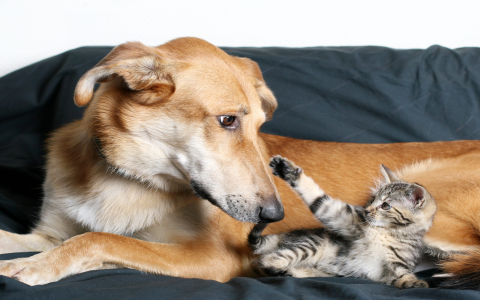

Title: Can a Cat and a Dog Breed?
Introduction:
People have long wondered whether a cat and a dog could ever produce offspring together. Although the two animals are popular pets, they belong to separate biological families that diverged millions of years ago. This article reviews why cross-breeding between them is considered impossible, examines the scientific barriers involved, and summarizes what researchers currently believe.
Genetic Differences Between Cats and Dogs
Cats and dogs sit on distant branches of the mammalian tree. Domestic cats possess 19 pairs of chromosomes, whereas dogs carry 39 pairs. Such a wide gap in chromosome number and gene arrangement prevents the formation of compatible sex cells, making fertilization biologically unfeasible.
Hybridization: A Rare Occurrence
While hybrids can form within the cat family—such as the offspring of a domestic cat and a small wild feline—or within the dog family—like wolf–dog mixes—no verified case exists of a true cat–dog cross. Reports of supposed mixes have always traced back to either hoaxes or mistaken identity.
Even when closely related species do hybridize, the resulting young are frequently infertile. The greater the genetic distance, the lower the chance of producing viable offspring at all.

Biological Barriers to Breeding
Beyond genetics, reproductive anatomy and behavior create additional roadblocks. Female cats ovulate in response to mating, whereas dogs follow a biannual heat cycle. Their courtship signals, mating postures, and genital structures are incompatible, so natural mating cannot proceed.
Even if sperm and egg were brought together artificially, the differing gene sets would halt early embryonic development long before birth.
Expert Opinions on Cat and Dog Breeding
Leading reproductive biologists agree that the divide between Felidae and Canidae is too wide to bridge. Specialists in animal genetics emphasize that successful hybridization requires a much closer evolutionary relationship than these two families share.
Behavioral researchers add that the species’ distinct social and mating rituals further eliminate any chance of spontaneous pairing.
Conclusion
All available evidence shows that cats and dogs cannot interbreed. Genetic incompatibilities, differing chromosome numbers, and mismatched reproductive strategies form an insurmountable barrier. Occasional urban legends notwithstanding, science treats the idea as a biological impossibility.
Interest in the topic persists, yet continued research focuses on conserving each species separately and understanding their unique reproductive biology rather than pursuing unattainable crosses.

Recommendations and Future Research
Scientists can better serve animal welfare by directing efforts toward the following areas:
1. Mapping the specific genes that control fertility in both cats and dogs to improve breeding programs within each species.
2. Studying how environmental factors influence reproductive cycles, with the goal of enhancing captive breeding of endangered relatives such as small wild cats or wolves.
3. Advancing assisted reproductive techniques like semen preservation and embryo transfer, but strictly within the same species, to support conservation and veterinary medicine.
By deepening our knowledge of feline and canine biology separately, we can protect genetic diversity and ensure healthier companion animals without chasing impossible hybrids.